The Real Cost of Running LLMs On-Premise (It's Not What You Think)
GPU bills, hallucinations, and the dream of free AI inference. A full TCO breakdown including the 40 hours of debugging nobody talks about.
Sarah, an engineering director at a mid-size logistics firm, pulled the trigger on a local GPU after her cloud inference bill hit $8,000 in a single month. The hardware arrived on a Tuesday. By Friday she had CUDA working. By week three she had her first pipeline running.
Modest monthly power. That was the surprise after the first full month. A local GPU running 24/7, serving inference from several automation workflows simultaneously — including one that fires on a schedule, makes dozens of model calls per run, and never sleeps. A hundred thousand tokens a day, minimum. The power line item was modest — not free, but a fraction of equivalent cloud API spend for the same volume.
I stared at that number for longer than I should have, because it's genuinely disorienting. One heavy afternoon on a frontier cloud API at that request volume costs more. And yet — and this is the part the "free local inference" crowd skips — the power bill is not the real number. Not even close. The real number is harder to face.
The Actual TCO Breakdown
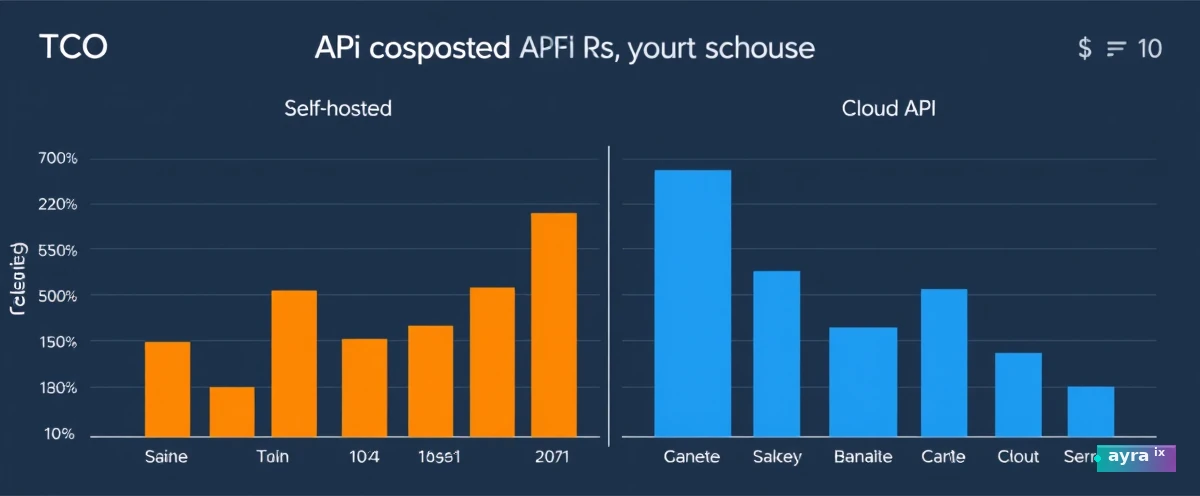
Vague claims about "saving money on API costs" are how self-hosted projects lie to themselves. Here are my actual numbers across the first three months.

Self-Hosted (this rig)
Cloud API Equivalent
| Cost Item | Amount | Notes |
|---|---|---|
| GPU (hardware) | Mid-range card | Amortized over 24 months |
| Host upgrade (additional RAM) | One-time kit | Amortized over 24 months |
| Electricity (GPU + system at 24/7) | Modest monthly | Low–mid hundreds of watts total draw |
| Total monthly run cost | ~$58–73/mo | Including hardware amortization |
| Cloud API equivalent (my volume) | $180–240/mo | frontier API model at my request volume + context |
| Net monthly savings | $107–180/mo | After breakeven in month 4 |
The math works — but only with a specific usage profile: high volume, repetitive tasks (job classification, extraction, structured output), privacy-sensitive data that cannot leave the network, and willingness to accept "very good" instead of "state of the art." Below 100 calls/day, the API is cheaper once you count your time honestly.
The Hidden Cost Nobody Puts in the Spreadsheet
Here is what "free local inference" actually costs: forty hours of my life in the first three months that had nothing to do with building AI systems.
CUDA driver conflict after a host OS kernel update — four hours. Ollama hostname resolution breaking after a Docker network change — six hours. A model producing silently corrupted JSON output that turned out to be a GPU memory allocation bug — eight hours. GPU sitting at 60% utilization during a batch job for reasons I still can't fully explain — three hours of profiling. Miscellaneous config drift, model redownloads, and Ollama version pinning — the rest.
What did those forty hours teach me that I wouldn't have learned from an API? Genuinely: how inference engines allocate GPU memory under concurrent load, how Docker networking interacts with GPU passthrough on a self-hosted NAS, how context window size affects system RAM (not just GPU memory) in ways the benchmarks don't show. That knowledge is now part of how I design systems. It was not free. It was paid for in the most expensive currency there is.
The question is not whether you'll pay that cost — you will. The question is whether you're going in with eyes open. A cloud API call costs money the moment you make it. A local inference call costs time, invisibly, spread across months of ownership. Both are real. Only one shows up on a bill.
The RAM Lesson Nobody Writes About
Every local LLM guide focuses on GPU memory — and it matters. But I hit a hard wall at modest system RAM long before I hit the GPU memory ceiling. Large context windows were causing the host OS to page aggressively, slowing inference to a crawl that negated every advantage of having the GPU. The fix wasn't a better GPU. It was upgrading system RAM — a kit that made more difference to real-world throughput than any model optimization I tried. If you're running 14B+ models with long contexts: spec your system RAM like it matters, because it does.
The Privacy Argument (The One Most Posts Skip)
Volume is a spreadsheet argument. Privacy is a different kind of argument — and it's the one that actually drove my decision.
Consider what my pipelines process. Document ingestion workflows: structured records, version history, every revision of generated output. Form automation pipelines: contact details, preference data, personal statements. A daily reflection system: what I'm worried about, what I'm working toward, what I think about people I work with. Infrastructure health monitoring: which services are running, what state they're in, the shape of the whole system.
None of that leaves this building. Not one token of it goes to OpenAI, Anthropic, Google, or any cloud provider. It runs on a GPU sitting three feet from me, processed by a model that has no network access, no logging to anyone else's servers, no terms of service that give a corporation rights to my career data. That's not paranoia. That's a deliberate architecture decision about which data I'm comfortable externalizing and which I'm not.
Most "local LLM" posts frame privacy as a bonus feature — nice to have, not necessary. I'd invert that. Once you systematically audit which of your workflows process personal data, you realize how much of it you've been casually sending to third-party infrastructure. Local inference doesn't just change the cost equation. It changes what you're willing to build.
Where the API Still Wins
I use frontier cloud APIs and Claude without apology for specific things, despite having capable local GPU inference available:

- Frontier-level reasoning — architectural decisions, complex multi-step debugging, writing that needs to be genuinely good
- One-off tasks where local setup overhead exceeds the cost of just making an API call
- Anything where a wrong answer has real consequences and 14B capability isn't enough
- Tasks involving public data where privacy isn't a factor and quality matters most
The 14B capability ceiling is real. Local models are excellent at classification, extraction, structured output, and pattern-matched code completion. They are unreliable at nuanced judgment and complex reasoning chains. Know the ceiling. Route accordingly. Hybrid is not a compromise — it's correct architecture.
The One Question Before You Buy the GPU
If yes: buy the GPU. The economics and the privacy case both hold. If no: the API is cheaper, faster to start with, and zero maintenance overhead. There's no shame in that answer. The mistake is buying hardware for occasional use and pretending the 40 hours of infrastructure work doesn't count as cost.
Modest monthly power. Hardware amortizes cleanly. The RAM upgrade was worth every dollar. The forty hours of debugging were paid forward — that knowledge is now structural. And the model that runs my automation pipelines, watches my infrastructure, and handles my daily reflections is sitting three feet from me, thinking on my hardware, sending nothing anywhere.
That's the real cost. And it's worth it — if you go in knowing what you're actually buying.
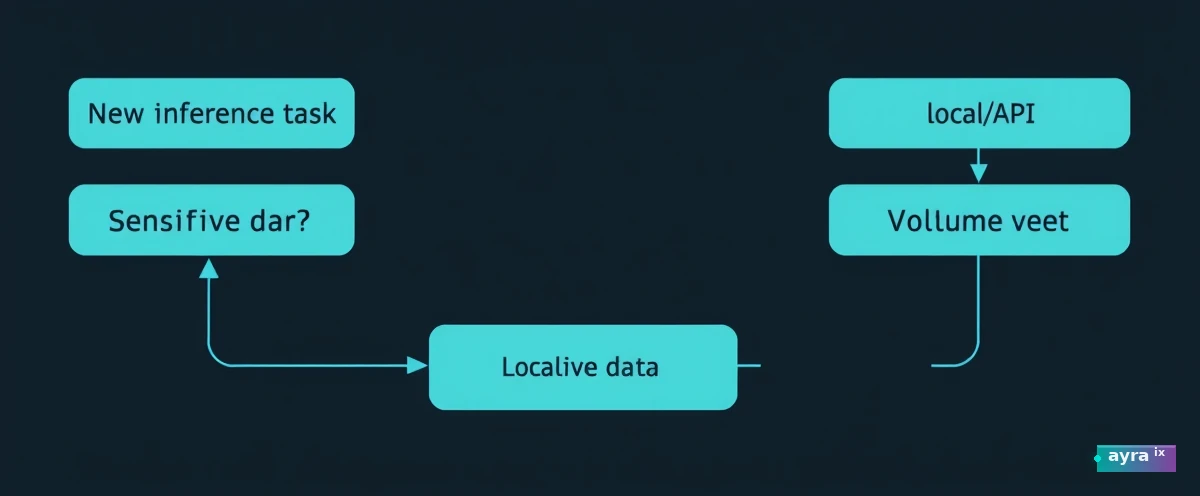
Your move: Before you buy anything, pull up your cloud API billing for the last three months. Count total tokens, sum the cost, and divide by 30. If the monthly number is above the amortized cost of a mid-range GPU (roughly $25–30/month over 24 months), the economics deserve a spreadsheet. If it's below, keep paying the API bill — your time is worth more than the savings. Either way, run one pipeline on local inference, not to save money, but to learn what you don't know yet.
"Forty hours of CUDA debugging is not a tax. It's tuition. But you should know which one you're paying before you buy the GPU."
Stay with us · poll
What Factors Influence Your Decision Between On-Premise and Cloud Hosting for LLMs?
As you weigh the pros and cons of running large language models on-premise versus in the cloud, what factors do you consider most important? Share your thoughts below!
No account needed — pick a take, then keep reading. We rotate these prompts so each piece feels like a conversation, not a clone.